Monday, June 20, 2011

Insulflex® Heat and Sound Proof Material


Insulflex® Heat and Sound Proof Material (non adhesive)

This is HIGH QUALITY product proven with :

Sound & Product Stability
SIRIM BS476 Part 6
SIRIM BS 476 PART 7
SIRIM Certificate (Aug 2010-Aug 2011)
SIRIM (Acoustic Test Report)

Sound Rated at : NRC 0.14

Warrington Research Certificate
TUV SUD BS476 Part 6
TUV SUD BS476 Part 7

SUITABLE for all cars.
Worth your money to buy this HIGH QUALITY product.
Why risk to buy a low quality just to save a few ringgit that has no effect?
Just use a 10mm or 6mm of this HIGH QUALITY
product to get the same result with a minimum space in tight and small area..

Recommended to use on :
1. Doors(Dootrims/Door Panel)
2. Front bonnet
3. Rear trunk lid
4. Boot floor and walls
5. Floor pan
6. Front fender / wheel arch
7. Roof Liner
8. Engine firewall from engine(best result)

Facts:
1 -Great for a quiet and comfortable
2 - Lightweight material
3 - Low water absorption rate(waterproof)
4 - Fireproof
5 - The above average physical properties are values obtained in accordance
with accepted test methods.

FOR BEST RESULT, stick/paste the bitumen type as a first layer
than add INSULFLEX on top of it as a second layer.


Standard Sheet Sizes: 3ft x 4ft
Thickness : Available in 10mm

Price List for More than one sheet:

PRICE TO BE REVISED DUE TO PRODUCTION COST RAISE..PLS CALL FOR MORE INFORMATION

COD at Taman TTDI Jaya & Shah Alam Area
Postage is arrangeable

Note :
*Minimum Order For Postage is 3 Sheet(9ft)
*Postage cost is paid by buyer
*Postage is through Pos Malaysia E-Parcel,will be delivered within 1 week
after payment is confirmed
*Dunlop GP Adhesive/Dunlop CA Adhesive can be used as adhesive as it just
rm10-20 per can..combine all cost,it's a cheap DIY..
Malaysia BOLEH!Dont be a lazy bump!


!!Installation Provided Now!!


CALL
NO SMS

Khairul
0179705607


!!Important Annoucement!!

Due to rise in production cost,the product price in now increased

Previous price is now revised to suit the current cost price..

Please CALL for further information

Sorry for inconvenience & thank you for your support..

Insulflex Soundproof and Heat Insulation


Installation on Proton Exora (4 Doors) with bitumen strip for best result..


Installation on rear passanger..Almost sound deadening result!!


Installation on Doorcards

Improves audio sound system & NVH instantly!!


Installation on Rear Shock Tower

Video upload for fire proof test


CLICK BELOW TO VIEW

http://www.youtube.com/watch?v=fehC5VAuqv0 <<

Sunday, June 19, 2011

Noise Reduction Coefficient (NRC)

From Wikipedia, the free encyclopedia

The noise reduction coefficient (commonly abbreviated NRC) is a scalar representation of the amount of sound energy absorbed upon striking a particular surface. An NRC of 0 indicates perfect reflection; an NRC of 1 indicates perfect absorption.

Building materials, especially interior finishes, through standard testing earn ratings of STC (Sound Transmission Class) and NRC based on their sound characteristics. NRC generally applies to a single material such as on the surface of a wall which determines the reverb or liveliness of a room. STC generally applies to the assembly that composes the wall, including framing, insulation, sheet products (gypsum wallboard for example) and a surface material (such as vinyl wallcovering) which limits the amount of sound that travels through the wall assembly into an adjacent space.

NRC (Noise Reduction Coefficient) is an arithmetic value average of sound absorption coefficients at frequencies of 250, 500, 1000 and 2000 Hz indicating a material's ability to absorb sound.

In particular, it is the average of four sound absorption coefficients of the particular surface at frequencies of 125, 250 Hz, 500 Hz, 1000 Hz, 2000, and 4000 Hz. These frequencies encompass the fundamental frequencies and first few overtones of typical human speech, and, therefore, the NRC provides a decent and simple quantification of how well the particular surface will absorb the human voice. A more broad frequency range should be considered for applications such as music or controlling mechanical noise.

Specifications for materials used in sound absorption commonly include an NRC for simplicity, in addition to more detailed frequency vs amplitude charts.

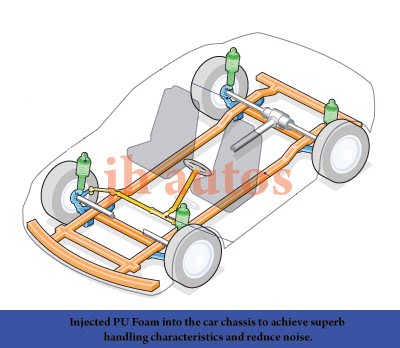
Injected PU FOAM (COMING SOON!)


Injected PU FOAM (fire retardant) in chassis cavity provides
less noise intrusion from underbody,wheel arch and tyre


Graphic shown PU Foam injected area

Spray foam seals off hollow points of the car's body.

Windshield Pillar (A Pillar)

Center Pillar (B Pillar)

Rear Pillar (C Pillar)


!!COMING SOON!!


How to Reduce Exhaust Noise

How to Reduce Exhaust Noise

The amount of noise an exhaust system produces depends on the engine installed and the exhaust system connected to the engine. Engine combustion gases exit your auto's engine through the exhaust manifold and travel to the tail pipes through the muffler. The muffler may contain chambers, baffles or sound dampening materials to modify the sound profile of the exhaust. While some sound is transferred through vibration outside the exhaust system as the exhaust gasses are expelled, the tailpipe becomes the primary point of sound wave escape.

Instructions

Things You'll Need

  • Exhaust wrap
  • Acoustic dampening material
  • Resonated exhaust tip
  • Muffler
    • 1 Install a layer of sound dampening pads at the metal surfaces in the vehicle cab. Cut acoustic dampening sheets to place between the carpet, upholstery and door coverings to dampen the sound vibrations allowed to enter the cab of the vehicle. Acoustic dampening sheets also decrease external sounds such as road noise, wind and traffic sounds, and may add clarity to sounds inside the cab (such as the audio system).
    • 2 Install a high-temperature exhaust wrap around the muffler and pipes. Wrap and attach (according to manufacturer's instructions) the exhaust wrap to dampen the vibrations that may pass through the exhaust into the cabin.
    • 3 Change the muffler in the exhaust system. Exhaust gases converge in the muffler. If the muffler is designed to increase the sound presence of the exhaust system (such as 'glass-packs or open-pipe muffler systems), exchanging the muffler to a dampening system will reduce the sound presence of the exhaust. If a dual exhaust system is installed (with two exhaust pipes extending from the engine) allowing both exhaust pipes to enter a dual-in muffler will allow the gasses and associated sound waves to collide and be dampened or mellowed prior to exhaust. Select a muffler based on chamber design, baffling, and acoustic dampening that is designed to reduce the noise output.
    • 4 Repair exhaust leaks. Exhaust leaks allow exhaust gasses and associated sound waves to escape before dampening.
    • 5 Install a resonated exhaust tip. Resonated exhaust tips are internally lined with fiberglass or other sound dampening material. The resonated tip is installed on the exhaust pipe to allow the final escape of gasses and sound waves to be dampened by the lining.

Tips & Warnings

  • If installing an exhaust wrap, be sure the exhaust wrap will not insulate the muffler beyond manufacturer recommendations. Exhaust wraps that insulate the exhaust system may raise the temperature of the muffler to the point at which the baffles degrade or smells are produced.

  • Do not wrap the catalytic converter. Temperature exceeding specifications of may result in damage to the catalytic converter.

Original source links : http://www.ehow.com/how_7151682_reduce-exhaust-noise.html